Refraction Through a Glass Slab and Refractive Index
Refraction
The shortest path need not be the quickest path. Since light is always in a hurry, it bends when it enters a different medium as it is still following the quickest path. This phenomenon of light bending in a different medium is called refraction.
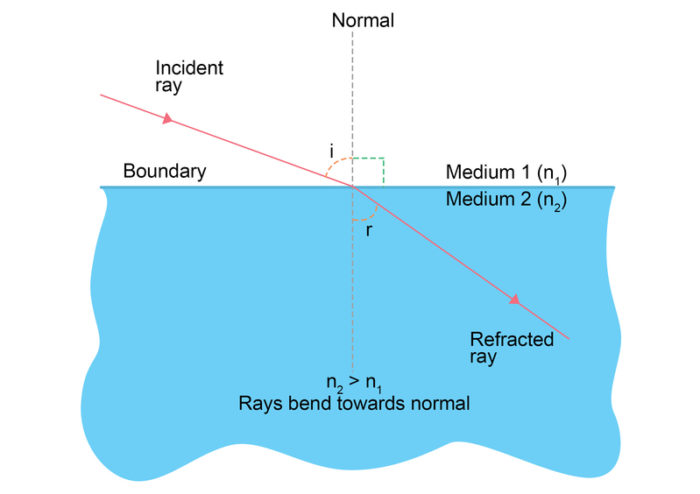
Laws of Refraction
- The incident ray, the refracted ray and the normal to the interface of two transparent media at the point of incidence, all lie in the same plane.
- The ratio of the sine of the angle of incidence to the sine of the angle of refraction is a constant, for the light of a given colour and for the given pair of media. This law is also known as Snell’s law of refraction.
Absolute and Relative Refractive Index
Refractive index of one medium with respect to another medium is called relative refractive index. When taken with respect to vacuum, it’s known as an absolute refractive index.
Refraction through a rectangular glass slab
When the light is incident on a rectangular glass slab, it emerges out parallel to the incident ray and is laterally displaced. It moves from rarer to denser medium and then again to the rarer medium.
Refraction at a planar surface
Following Snell’s Law:
- Light bends towards the normal when moving from rarer to denser medium at the surface of the two media.
- Light bends away from the normal when moving from denser to rarer medium at the surface of contact of the two media.
Refractive Index
The extent to which light bends when moving from one medium to another is called refractive index. This depends on the ratio of the speeds in the two media. The greater the ratio, more the bending. It is also the ratio of the sine of the angle of incidence and the sine of the angle of refraction, which is a constant for any given pair of media. It is denoted by:
n = sin∠i/sin∠r = speed of light in medium 1/speed of light in medium2.
Total internal reflection
- When the light goes from a denser to a rarer medium it bends away from the normal. The angle at which the incident ray causes the refracted ray to go along the surface of the two media parallelly is called critical angle.
- When the incident angle is greater than the critical angle, it reflects inside the denser medium instead of refracting. This phenomenon is known as Total Internal Reflection.
E.g mirages, optical fibres.

 Teenager Helper