Spherical Lens
Refraction at curved surfaces
When light is incident on a curved surface and passes through, the laws of refraction still hold true. For example lenses.
Spherical lenses
Spherical lenses are the lenses formed by binding two spherical transparent surfaces together. Spherical lenses formed by binding two spherical surfaces bulging outward are known as convex lenses while the spherical lenses formed by binding two spherical surfaces such that they are curved inward are known as concave lenses.
Important terms related to spherical lenses
- Pole (P): The midpoint or the symmetric centre of a spherical lens is known as its Optical Centre. It is also called as the pole.
- Principal Axis: The line passing through the optical centre and the centre of curvature.
- Paraxial Ray: A ray close to principal axis and also parallel to it.
- Centre of curvature (C): The centres of the spheres that the spherical lens was a part of. A spherical lens has two centres of curvatures.
- Focus (F): It is the point on the axis of a lens to which parallel rays of light converge or from which they appear to diverge after refraction.
- Focal length: Distance between optical centre and focus.
- Concave lens: Diverging lens
- Convex lens: Converging lens
Rules of ray diagram for representation of images formed
- A ray of light parallel to principal axis passes/appears to pass through the focus.
- A ray passing through the optical centre undergoes zero deviation.
Image formation by spherical lenses
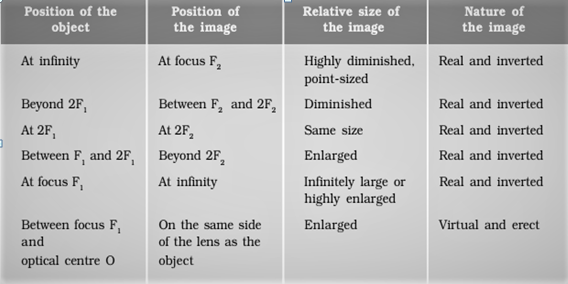
The following table shows image formation by a convex lens.

 Teenager Helper